
Beaumont Previous Residents by Era
One Beaumont address is best treated as an overlap of Beaumont sources, not as a single historical list. Current Beaumont parcel and official-record searches can identify the land and recorded transfers. Tyrrell Historical Library links older Beaumont deeds, directories, microfilm, newspaper material, and other local records. The date in each column is a coverage statement for that source, not a promise that every Beaumont address appears continuously.
| Source | Years it covers | Where held | What it shows |
|---|---|---|---|
| Jefferson County deed index for Beaumont | 1836-1946 | Tyrrell Historical Library in Beaumont | Beaumont conveyances, names, and legal descriptions |
| Current official deed index for Beaumont | Online start not stated | Jefferson County Clerk portal for Beaumont | Beaumont grantor, grantee, property records, and OCR discovery option |
| Beaumont city directories | 1903 start page; 1904-present newsletter | Tyrrell Texana shelves in Beaumont | Annual address, Beaumont occupant, occupation, and business clues |
| Beaumont Sanborn fire-insurance map | 1904 confirmed, 26 sheets | Library of Congress Beaumont scan | Beaumont building footprint, use, material, and street context |
| Federal census for Beaumont households | Public through 1950 | Census, NARA, and Beaumont library sources | Beaumont household on an enumeration date |
| Beaumont permits, code, probate, and newspapers | Varies; historical start often unstated | Beaumont City, County Clerk, and Tyrrell | Beaumont construction dates, estate clues, notices, and obituaries |
Begin with the most recent Beaumont parcel details when the address is known. Move to the Beaumont historical index when the current portal no longer reaches the needed period. Beaumont directories and census records address the household question, while Beaumont maps and permits help date the building itself.
Start Beaumont Previous Residents at JCAD
Jefferson Central Appraisal District Property Search is the current Beaumont starting point for an address trail. Capture the Beaumont owner name, mailing address, situs address, legal description, Geographic ID, Property ID, tax year, and the date searched. The Beaumont situs address identifies the land or building. The mailing address is where a tax notice goes. They can differ, so a Beaumont mailing result is a lead that needs another record, not proof that a person lived at the parcel.
For a difficult Beaumont street, JCAD advises omitting prefixes, suffixes, and unit numbers from the street field. Try a number and simple Beaumont street name, then use a Beaumont owner surname, Geographic ID, Property ID, or tax account as needed. Preserve lot, block, subdivision, acreage, and any metes-and-bounds wording because those parts of a Beaumont legal description often survive an address change better than a house number.
Note: Save the tax year with every Beaumont JCAD result because appraisal rolls and parcel details can change after the search.
Jefferson Deeds Trace Beaumont Previous Residents
The Jefferson County Official Records Search is the Beaumont deed-chain tool after the current parcel is identified. Search the current Beaumont owner as grantee around the acquisition date. A grantee is the party receiving property. Locate the Beaumont purchase deed and record its date, document number or book and page if shown, plus its legal description. Then search the seller or prior grantor as a grantee for the earlier Beaumont purchase and repeat one transfer at a time.
- Save the JCAD owner, legal description, Geographic ID, and current tax year for the target Beaumont parcel.
- Search the Beaumont owner as grantee in official records around the apparent acquisition date and locate the purchase deed.
- Copy the Beaumont recording date, document identifier, lot and block or metes-and-bounds description, and named grantor.
- Search that Beaumont grantor as a prior grantee, using name variants, initials, estates, trusts, and corporate names when needed.
- Continue the Beaumont deed trail deed by deed, switching to the legal description when the street address no longer matches.
- Grantor and grantee
- The grantor transfers an interest in property. The grantee receives it. In a purchase deed, the prior holder is commonly the grantor and the buyer is the grantee.
- Chain of title
- The sequence of recorded transfers associated with a parcel. It can identify prior owners, but it does not by itself name every person who occupied an address.
- Legal description
- The lot, block, subdivision, or metes-and-bounds description used in property records. It is often steadier than a street address when a parcel is replatted or a street changes.
The Beaumont portal's landing page does not state its online beginning year. OCR or full text can help discover a record, but it is not a substitute for checking the indexed Beaumont deed and its image or copy requirements. The County Clerk's Beaumont counter, mail, or email channels are the fallback for documents the public search does not expose.
The Jefferson County Official Records Search shows the Beaumont quick-search and date-range controls used to begin a deed chain.
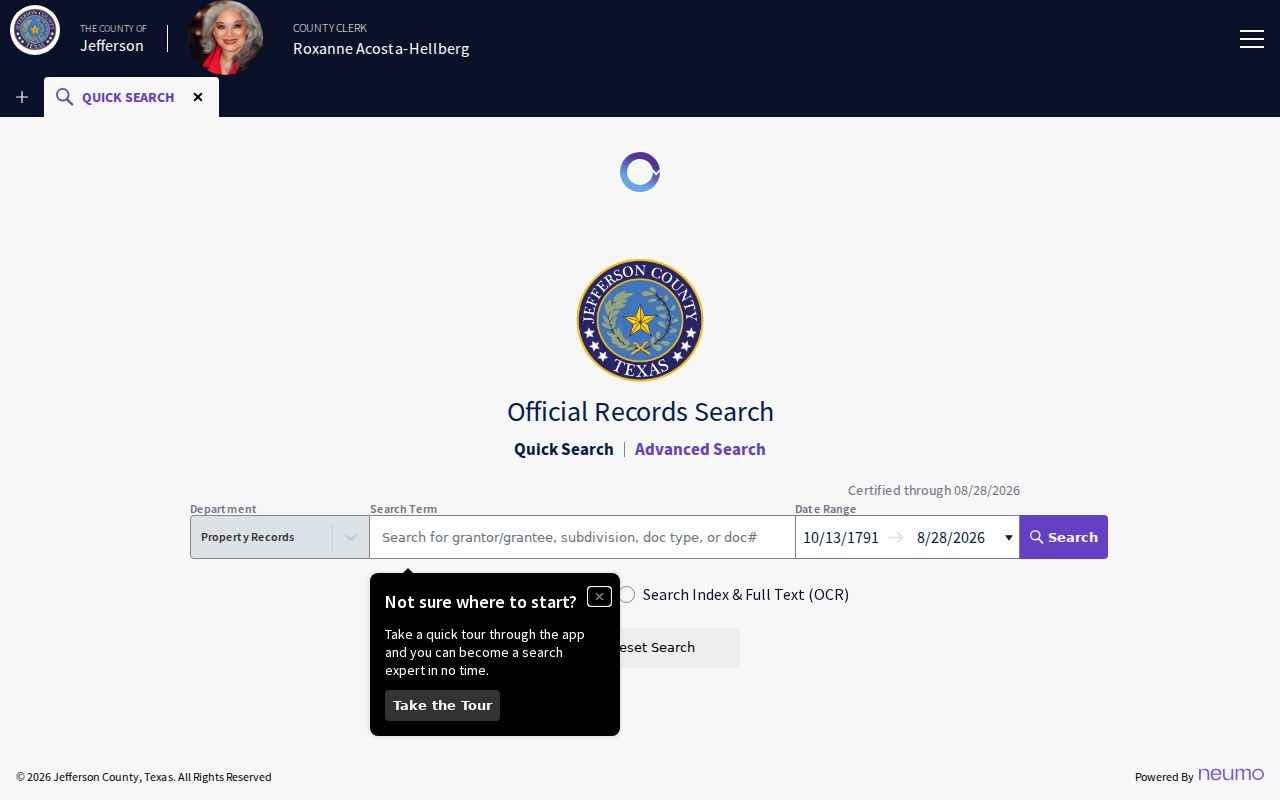
Use its index and OCR choices to discover a Beaumont instrument, then preserve the document number and legal description before moving to the prior transfer.
Beaumont Previous Residents Beyond the Portal
When the online deed search stops, Beaumont's Genealogy Research page points researchers to directories, atlases, newspapers, microfilm, databases, and librarian or archivist assistance. No standalone city house-history guide was located. Tyrrell's Jefferson County Index to Deeds, which reaches 1836-1946, is the documented historical bridge. Ask the County Clerk about deed books or microfilm for periods not covered by either route.
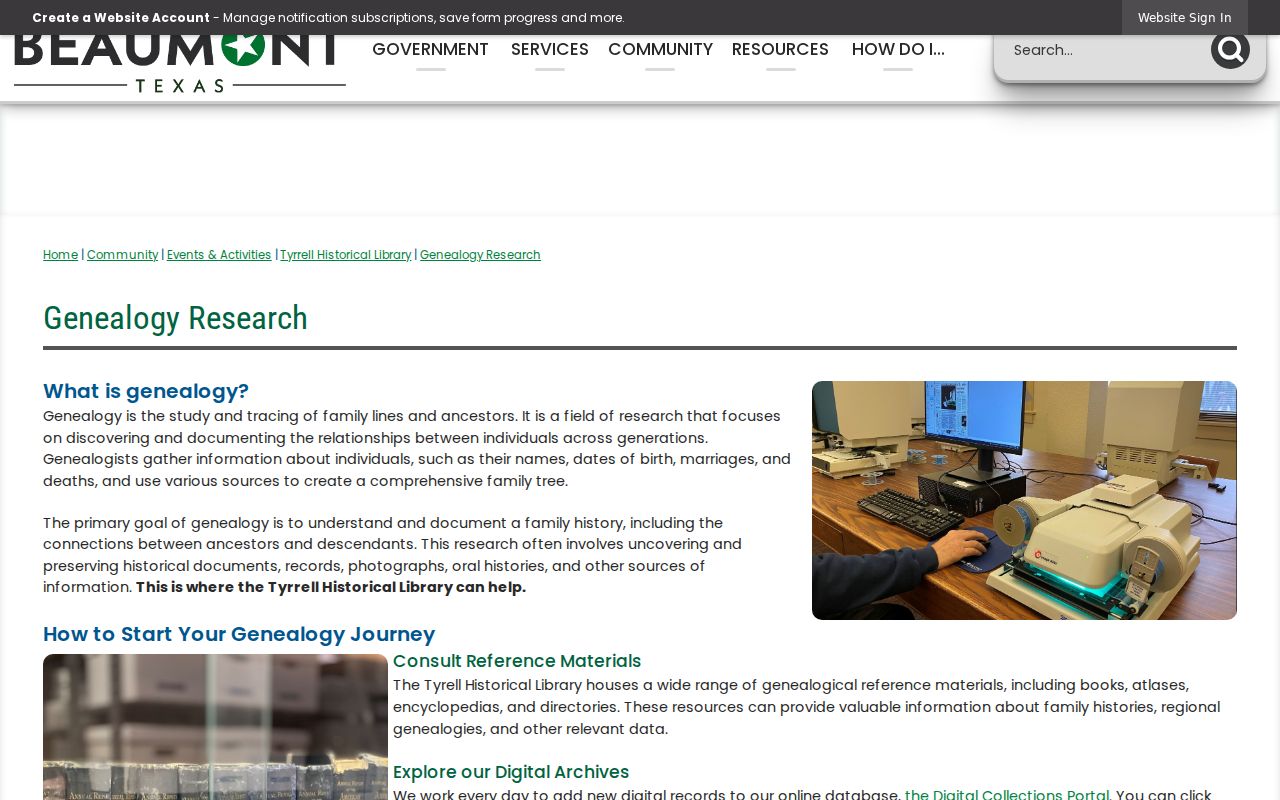
The Beaumont research service reported in the April 2026 library newsletter costs $10 per hour and can cover local history, genealogy, and Enterprise or Journal microfilm. Tyrrell's Beaumont microfilm readers can crop, save, email, and print. That service is useful when a Beaumont family has several spellings or the address needs to be tracked across many years.
Tyrrell also lists historical tax rolls, probate material, local marriage records from 1837-1883, Texas birth and death indexes, and census microfilm among its local-history resources. These are supporting records. They can clarify a household change or estate event, but the legal description and recorded deed sequence remain the stronger parcel trail.
Beaumont Previous Residents Through a 26-Sheet Map
The Library of Congress 1904 Beaumont Sanborn map was created and published by the Sanborn Map Company in August 1904. Its 26 sheets are public domain and provide a strong address-context check. A sheet can show a building footprint, number of stories, construction material, use, outbuildings, and the surrounding street pattern. It may reveal whether the location was a dwelling, store, industrial building, church, or vacant lot at that time.
The map does not identify ordinary occupants or establish title. Use it after the deed and directory work to test the physical setting of the address. A property described as a residence in a later directory can have had a different use in 1904, so the date on the source matters as much as the street name.
Note: The 1904 Sanborn volume provides building context, not a list of past residents or a complete ownership record.
Beaumont Previous Residents Need Address Continuity
Annexation, subdivision work, replatting, street renaming, street-number adjustments, prefixes, and unit numbers can interrupt an exact address search. The research did not locate a dated Beaumont-wide renumbering or renaming project. That absence is an open question, not evidence that a historic number never changed. Keep both the printed address and the legal description in the house file.
The Beaumont City Clerk keeps annexation proceedings, ordinances, deeds, easements, and official city records. County and City Clerk plats can connect a lot and block to a changed street layout. For construction or enforcement timing, the city's interactive maps link permits and code information, but the city warns that public maps are not official maps. Request an official file when a date or detail will matter.
Past Beaumont Households in Directories and Census
Recorded ownership is only one part of an address history. Beaumont directories can give annual occupant, address, occupation, spouse, or business clues, while the census can show household composition, ages, relationships, and residence on the enumeration date. The city directory collections themselves are described on the Beaumont city directory page, so the backward address trail can stay focused on matching years and names.
Use this sequence for a household timeline: exact address in the earliest usable directory, then the alphabetic and street portions of each available edition, then name variants and prefixes, followed by the 1900 through 1950 census years. The federal 72-year release rule explains why the public census trail ends well before current records. A directory entry can build a candidate list, but it does not prove who owned the parcel or every person present there.
Address to household flow: parcel and legal description to deed transfer, deed date to the nearest directory edition, directory name to census household, then newspaper, vital, or probate material to test a move or death.
Beaumont Previous Residents Reach Probate Endpoints
Tyrrell's claimed full Enterprise and Journal run can fill gaps between directory editions with obituaries, announcements, legal notices, and move-related news. HeritageHub is available online to current library-card holders for obituary and death-notice research. A notice may give a date, spouse, children, prior residence, funeral home, or cemetery. Treat those details as leads and verify an important identity or event with the appropriate vital-record or clerk source.
Probate can provide an executor, heirs, property references, and the date an estate entered the court process. Search the County Clerk for estate files and use the historic tax and probate material at Tyrrell for older work. A deed after an estate transfer can reconnect the parcel to the next owner, while an obituary may explain why a name disappears from an address trail.
Limits on Beaumont Previous-Resident Research
Previous-resident work should distinguish ownership from ordinary occupancy. A deed can establish a recorded transfer. A tax mailing address can identify a notice recipient. A directory and census can place a household at an address at a particular time. None is a complete record of every person who ever lived there, and neither utility accounts nor protected information belong in a public house-history file.
Lawful use. Use Beaumont address history for family research, estate questions, property curiosity, or civic context. Do not use records to stalk, harass, or harm a living person.
Keep citations with the source date, page or document number, search terms, and any uncertainty. A careful trail can say what is documented, what is inferred, and what still requires a clerk or archive check.